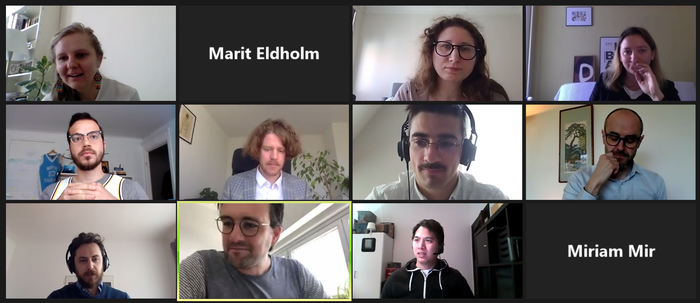
PhD defence
Radu-Mihai Triculescu defended his doctoral thesis Harmonised Asylum Policies in the European Union? The role of street-level bureaucrats in the implementation of the Common European Asylum System on 24 June 2021.
Current position
Postdoctoral Research Fellow at the Chair of Political Systems and European Integration, Ludwig-Maximilians-Universität München
PhD project
The Common European Asylum System (CEAS) has strived to provide a uniform set of guidelines aimed at harmonizing the implementation of asylum procedures across the European Union. My project will trace the instruments that make up the CEAS across different levels of governance, and track if and how differences emerge in the way countries absorb European Directives, Regulations, and other instruments, ultimately yielding different procedures of bureaucratic implementation. Essentially, the aim of this investigation is to understand how bureaucrats implement the Common European Asylum System in different Member States, and how can any differences in implementation be explained. Through a case study comparison, an understanding of how country-specific contexts affect the establishment of a comprehensive and harmonized asylum policy in the European Union will emerge. To observe these differences, much of the focus will be placed on the discretionary space available to bureaucrats involved in making asylum decisions.
- Supervisor: Ramses Wessel, University of Groningen (former University of Twente)
- Co-supervisors: Johannes Pollak, Institute for Advanced Studies and Claudio Matera, University of Twente
Secondment
- Centre for European Policy Studies (CEPS), Brussels
Background
My curiosity for studying migration policies stems from the simple fact that my entire life I have been a migrant myself, living in eight countries across five continents. After working as an international relations advisor to the Romanian Minister of Agriculture and Rural Development and later as a public affairs consultant in a major American-based consultancy firm in Romania, I made the decision to continue studying the topic which has stimulated my curiosity thus far. PLATO has offered the best opportunity to do this, by giving me the freedom to pursue my research interests while being part of a strong network of researchers, supervisors, and trainers. Nationality: Romanian.
- Erasmus Mundus Joint Master in International Migration and Social Cohesion, University of Amsterdam, Universidad de Deusto, and Osnabrück University
- MSc in International Affairs, Florida State University
- BA in International Affairs and Political Science, Florida State University
News
Publications
-
Why EU institutions alone cannot reform the Common European Asylum System
The aim of the Common European Asylum System (CEAS) is to harmonise asylum procedures across the European Union. As several crises have shown, however, this goal is far from being achieved, and a reform of Europe’s asylum policy is long overdue. Radu-Mihai Triculescu argues that such reform should also incorporate the perspective of street-level bureaucrats implementing the joint system in each EU member state. His original research suggests that the experience of these workers can offer the insights needed to make a generalised European asylum policy enforceable at the national level.
Post-Crisis Democracy in Europe blog, 27 July 2020

Presentations
-
PLATO kick-off conference
PLATO's kick-off conference brings together the project's partners in Oslo for academic discussions and networking.
-
Radu-Mihai Triculescu and Gil Thompson discussed their work at CEPS
CEPS organised an online meeting where PLATO visiting fellows Gil Thompson and Radu-Mihai Triculescu discussed their work with academics and practitioners in the field of Justice and Home Affairs.
-
PLATO panel at the ÖGPW Graduate Conference
A panel discussing PLATO research was organised as part of the Austrian Political Science Association's Graduate Conference in Vienna on 28-29 November 2019.
-
Synthesising research findings (RTC4)
ESRs will be presenting their contribution to the PLATO anthology and their overall research results, with an emphasis on the first.